

Many language learners and educators struggle to unlock the full potential of AI tools due to unclear guidance and setup confusion. AI-powered platforms promise personalized instruction and rapid progress, but without proper understanding, these tools underdeliver. This guide provides step-by-step instructions, identifies common pitfalls, and sets measurable outcomes to help you harness AI effectively for language acquisition.
Table of Contents
- Introduction To AI In Language Learning
- Prerequisites For Effective AI Language Learning
- Step-By-Step Integration Of AI Tools Into Language Practice
- Common Mistakes And Troubleshooting In AI-Assisted Language Learning
- Comparing AI And Traditional Language Learning Methods
- Safety, Privacy, And Ethical Considerations
- Expected Results And Outcomes Using AI Tools
- Enhance Your Language Learning Experience With Turbo Answer
- FAQ
Key takeaways
| Point | Details |
|---|---|
| AI personalizes learning | AI tools adapt exercises to your gaps, accelerating vocabulary retention and speaking confidence with measurable gains. |
| Preparation is essential | Success requires digital literacy, clear goals, stable internet, and choosing tools matching your target language and level. |
| Step-wise integration works best | Gradual adoption with consistent practice, real-time feedback review, and progress tracking prevents overwhelm and sustains motivation. |
| Blend AI with traditional methods | Combining AI platforms with human interaction and cultural immersion yields 25% higher proficiency scores over six months. |
| Privacy and ethics matter | Select AI platforms with transparent data policies, anonymization options, and user control to protect personal information. |
Introduction to AI in language learning
AI technologies in language education include adaptive feedback systems, multimodal inputs like speech recognition, and analytics dashboards that track learner progress. These tools personalize instruction by identifying individual weaknesses and tailoring exercises to address them. Real-time feedback on pronunciation, grammar, and vocabulary usage keeps learners engaged and motivated.
Key benefits include personalized lesson paths that adjust difficulty based on performance, increased engagement through gamification and interactive tasks, and immediate correction that accelerates skill acquisition. AI optimizes retention by spacing repetition intelligently and focusing practice on areas where you struggle most.
Challenges exist. Data privacy concerns arise when platforms collect voice recordings and personal learning data. AI cannot fully replace human interaction for nuanced cultural understanding or conversational spontaneity. Overreliance on automated corrections can hinder critical thinking and active language production. Balancing AI assistance with traditional study methods addresses these limitations effectively.
Core AI technologies transforming language learning:
- Adaptive feedback engines that adjust lesson difficulty in real time based on your mistakes and progress patterns
- Speech recognition and pronunciation scoring that provide instant corrections and model native speaker patterns
- Natural language processing for grammar checking and contextual vocabulary suggestions within writing exercises
- Analytics dashboards visualizing your retention rates, practice consistency, and proficiency growth over time
Prerequisites for effective AI language learning
Before integrating AI tools, ensure you possess basic digital literacy to navigate apps, adjust settings, and interpret progress data confidently. Set clear, realistic language learning goals such as achieving conversational fluency in six months or expanding vocabulary by 500 words in three months. Defined objectives help you select appropriate AI platforms and measure success.
Choose AI language tools compatible with your target language and current proficiency level. Not all platforms support less common languages or offer beginner-friendly interfaces. Verify the tool provides exercises at your skill tier to avoid frustration or boredom.
Ensure access to a stable internet connection and a compatible device, whether smartphone, tablet, or computer. Many AI platforms require consistent connectivity for real-time feedback and cloud-based progress tracking. Prepare to engage consistently with AI feedback and assessments, committing to daily or weekly practice schedules.
Pro Tip: Regularly revisit and adjust your goals based on AI progress data to maintain focus and adapt to evolving strengths and weaknesses.
Essential preparation steps:
- Assess your current digital skills and complete introductory tutorials if unfamiliar with app navigation or cloud-based learning
- Define specific, measurable language goals tied to timelines, such as passing a proficiency test or holding a 10-minute conversation
- Research AI platforms that specialize in your target language and offer features aligned with your learning style
- Test device compatibility and internet speed to ensure smooth app performance and uninterrupted practice sessions
- Commit to a realistic practice schedule that fits your lifestyle, aiming for consistency over intensity
Explore Turbo Answer pricing to find a plan that matches your learning budget and feature needs.
Step-by-step integration of AI tools into language practice
Set clear learning objectives aligned with your target language and proficiency level before starting. Complete onboarding tutorials to familiarize yourself with the AI tool's features, interface, and customization options. These introductions often include placement tests that calibrate the platform to your current skills.
Engage in personalized exercises where adaptive exercises target gaps and enhance retention by focusing on your specific errors. Start with beginner or intermediate tasks to build confidence, then gradually increase difficulty to avoid overwhelm and maintain motivation.
Utilize real-time feedback, particularly for speaking and pronunciation tasks, to correct mistakes immediately and reinforce proper patterns. Review AI analytics regularly to track progress metrics like vocabulary acquisition speed, speaking confidence scores, and retention rates. Adjust your learning approach based on these insights to address weak areas.

Pro Tip: Use the AI tool's reminder features to maintain consistent practice schedules and prompt assessments at optimal intervals for retention.
| Step | Rationale | Expected Benefit |
|---|---|---|
| Set clear objectives | Aligns AI exercises with personal goals and proficiency tier | Focused practice on relevant skills |
| Complete onboarding | Calibrates AI difficulty and familiarizes you with features | Personalized learning path from day one |
| Engage in adaptive exercises | Targets individual weaknesses with customized drills | Faster gap closure and skill improvement |
| Increase difficulty gradually | Prevents cognitive overload and sustains motivation | Steady progress without frustration |
| Use real-time feedback | Corrects errors immediately for better pattern reinforcement | Accelerated pronunciation and grammar mastery |
| Review analytics regularly | Identifies trends and informs strategy adjustments | Data-driven optimization of study time |
Integration checklist for daily practice:
- Log in and review your personalized lesson plan generated by the AI based on prior performance.
- Complete at least one speaking exercise using voice recognition to practice pronunciation and fluency.
- Engage with vocabulary drills that adapt to words you frequently miss or struggle to recall.
- Write short responses or essays where the AI provides grammar and style feedback instantly.
- Check your analytics dashboard to monitor weekly progress and identify persistent gaps.
- Adjust upcoming lesson difficulty or focus areas based on feedback and your comfort level.
- Set reminders for your next practice session to maintain consistency and momentum.
Explore the Turbo Answer widget demo to see adaptive feedback in action before committing to a subscription.
Common mistakes and troubleshooting in AI-assisted language learning
Avoid overreliance on AI translations, which can hinder active language production and critical thinking. Incorporate active speaking and writing practice beyond AI assistance by conversing with native speakers or joining language exchange groups. Regularly track progress and reassess learning plans to prevent stagnation and ensure your goals evolve with your skills.
Balance AI use with traditional study methods such as textbooks, cultural immersion activities, and human tutoring for best results. AI excels at personalized drills and instant feedback but cannot replicate spontaneous conversation or cultural nuance. Combining both approaches addresses gaps and builds well-rounded proficiency.
Pro Tip: Set periodic reminders to self-evaluate your learning goals and refresh strategies every month to stay aligned with progress and interests.
Privacy pitfalls arise when platforms collect extensive personal data without transparent policies. Choose AI tools with clear data handling practices, anonymization options, and user control over recorded speech and written exercises. Avoid platforms that share learner data with third parties without explicit consent.
Frequent user errors and solutions:
- Skipping onboarding tutorials leads to underutilizing features; always complete introductory lessons to maximize tool capabilities
- Passive interaction with feedback without revision prevents improvement; actively correct mistakes and revisit challenging exercises
- Inconsistent practice schedules reduce retention and slow progress; establish daily or weekly routines and use app reminders
- Ignoring analytics dashboards misses opportunities to optimize study focus; review progress metrics weekly to adjust strategies
- Relying solely on AI for speaking practice limits conversational skills; supplement with real conversations and language partners
- Neglecting privacy settings exposes personal data; configure privacy options during setup and audit them regularly
Comparing AI and traditional language learning methods
Fully AI-driven platforms offer scalability, 24/7 availability, and cost-effective subscriptions starting around $10 monthly. They personalize lessons based on individual performance and provide instant feedback on pronunciation, grammar, and vocabulary. However, they lack deep contextual understanding and cultural immersion that human tutors deliver.
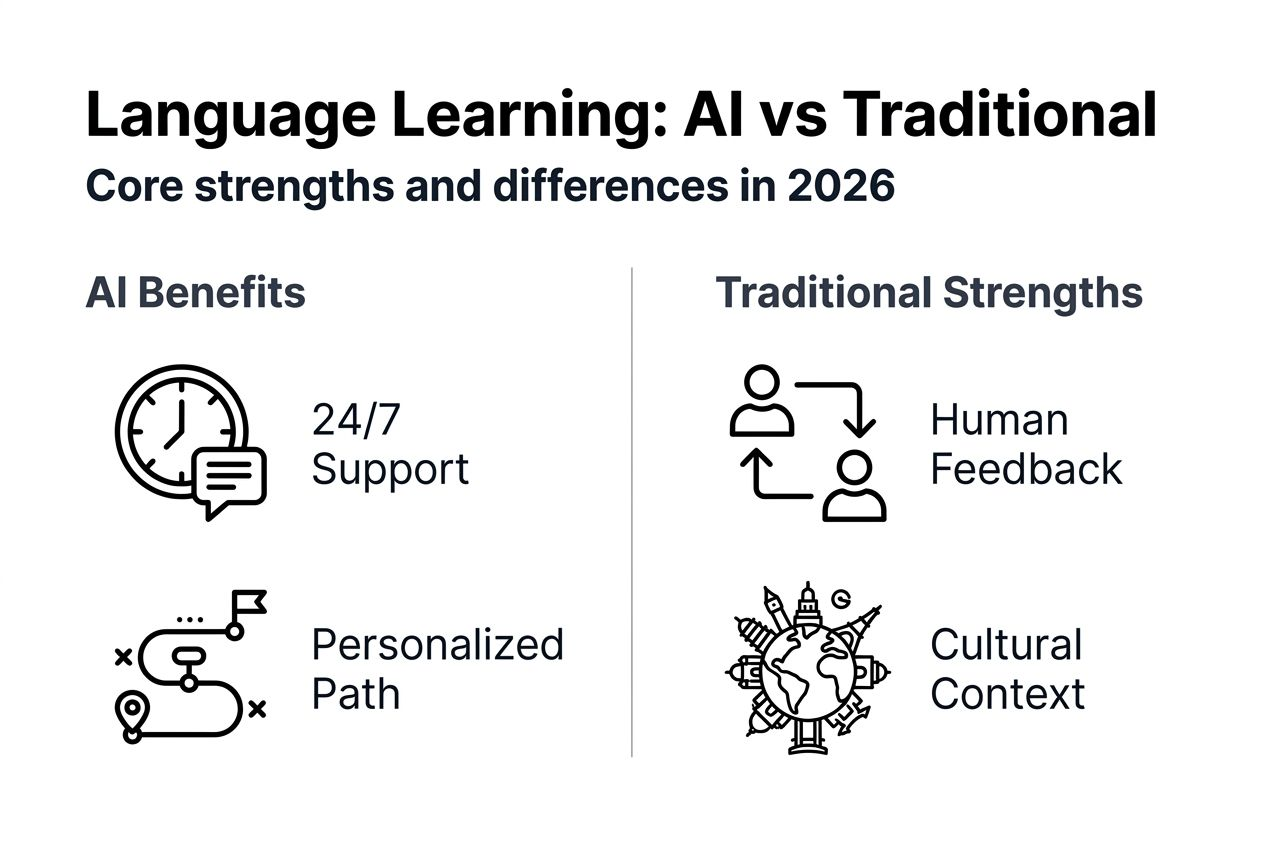
Human tutor AI hybrids combine personalized AI drills with scheduled live sessions for conversational practice and cultural insights. These models offer higher contextual learning but at 50% higher cost and slower scalability due to tutor availability constraints. They suit learners prioritizing nuanced communication and real-world interaction over speed and convenience.
Studies show that blending AI and traditional methods yields 25% higher proficiency scores over six months compared to using either approach alone. AI accelerates vocabulary acquisition and grammar mastery, while traditional methods deepen cultural competence and spontaneous speaking skills.
| Feature | AI-Driven Platforms | Traditional Methods | Hybrid Approach |
|---|---|---|---|
| Cost | $10-30/month | $30-60/hour tutoring | $40-80/month combined |
| Personalization | High (adaptive algorithms) | Moderate (tutor expertise) | Very high (AI + human insight) |
| Scalability | Unlimited users | Limited by tutor availability | Moderate (scheduled sessions) |
| Cultural context | Low (lacks nuance) | High (native speaker insight) | High (tutor supplements AI) |
| Real-time feedback | Instant (pronunciation, grammar) | Session-based (weekly) | Instant AI + weekly human review |
| Proficiency gain (6 months) | Moderate | Moderate | High (25% above either alone) |
Choosing the right approach depends on your goals, budget, and learning style. If you prioritize rapid vocabulary growth and flexible practice schedules, AI-driven platforms excel. For deep cultural immersion and conversational fluency, traditional tutoring or hybrid models deliver superior outcomes despite higher costs. Budget-conscious learners benefit most from starting with AI platforms and adding occasional tutoring sessions as skills advance.
Safety, privacy, and ethical considerations
Personal data privacy in AI language platforms poses significant concerns as tools collect voice recordings, written exercises, and behavioral analytics. A 2025 survey found that 68% of learners worry about how platforms use and share their data. Select AI tools with transparent privacy policies that specify data retention periods, anonymization practices, and third-party sharing limits.
Ethical AI use in education demands platforms avoid biases in language models and protect learner identity. Some AI tools inadvertently reinforce stereotypes or cultural biases through training data. Prefer platforms that audit models for fairness and allow users to report biased outputs.
Always review and configure privacy settings during initial setup to control data collection, storage, and sharing. Avoid platforms that require unnecessary permissions or lack clear opt-out mechanisms for data use beyond core functionality.
Tips for protecting identity and data:
- Read privacy policies thoroughly before signing up, focusing on sections about data storage, third-party access, and user rights
- Enable two-factor authentication to secure your account against unauthorized access and data breaches
- Use pseudonyms or limited personal information in profile creation if the platform allows anonymous learning
- Regularly audit app permissions on your device to ensure the AI tool accesses only necessary features like microphone or camera
- Opt out of data sharing for marketing or research purposes if the platform provides granular privacy controls
- Delete old recordings and exercises periodically if the platform offers user-managed data deletion features
- Research platform reputation and user reviews regarding data security incidents or transparency issues before committing
Expected results and outcomes using AI tools
Typical timelines for noticeable improvements include expanding vocabulary by 200-300 words within the first month of consistent daily practice. Speaking confidence and pronunciation accuracy show measurable gains after six to eight weeks of regular AI feedback and repetition exercises. Grammar mastery and sentence construction fluency often require three to four months of structured practice.
Metrics to track include vocabulary acquisition speed measured by new words learned per week, retention rate assessed through spaced repetition tests, speaking confidence evaluated via self-assessment or tutor feedback, and pronunciation error reduction scored by AI algorithms. Tracking these metrics motivates continued effort and highlights areas needing focus.
Expected proficiency improvements when combining AI and traditional study methods include advancing one CEFR level (e.g., A2 to B1) within six months for learners practicing 30 minutes daily. AI accelerates drilling and feedback loops, while traditional methods deepen contextual understanding and cultural fluency.
Cost considerations involve weighing subscription fees against learning gains. AI platforms typically cost $10-30 monthly, offering unlimited practice and instant feedback. Compare this to traditional tutoring at $30-60 per hour, where budget constraints limit session frequency. Hybrid approaches balance affordability and outcomes.
Realistic outcome expectations:
- First month: 200-300 new vocabulary words acquired, basic pronunciation improvements, and familiarity with grammar patterns
- Two to three months: Noticeable speaking confidence in simple conversations, 60-70% retention of learned vocabulary, reduced grammar errors in writing
- Six months: Advancement of one proficiency level, ability to hold 10-15 minute conversations, 500-700 word active vocabulary expansion
- Cost per proficiency level gain: Approximately $60-180 for AI-only approaches, $720-1440 for traditional tutoring, $240-480 for hybrid models
Encourage regular milestone tracking by setting monthly goals tied to specific metrics like vocabulary size, speaking session duration, or grammar accuracy percentages. Celebrate small wins to maintain motivation and adjust strategies when progress plateaus.
Enhance your language learning experience with Turbo Answer
Ready to apply the strategies outlined in this guide? Turbo Answer offers a versatile AI language learning platform powered by Google's Gemini 3.1 Pro, delivering personalized feedback, real-time progress tracking, and adaptive exercises tailored to your proficiency level. Supporting over 100 languages, it fits learners and educators seeking scalable, effective AI solutions.
Explore Turbo Answer pricing to find a subscription plan that matches your budget and learning goals, whether you're an individual learner or an educator managing classroom integration. Discover business solutions designed for institutions and teams requiring enterprise-grade AI language tools with advanced analytics and customization. Try the widget demo to experience the interface and adaptive capabilities firsthand before committing. Turbo Answer transforms the insights from this guide into practical, measurable language learning success.
FAQ
What types of AI tools are best for beginners in language learning?
Beginner-friendly AI tools feature simple interfaces, step-by-step onboarding tutorials, and basic adaptive exercises that adjust to your mistakes without overwhelming you. Look for platforms offering strong real-time feedback on pronunciation and grammar, along with gamification elements to sustain motivation during early learning stages.
How can educators integrate AI language tools effectively in classrooms?
Start by training yourself on the AI platform's features and customization options to confidently guide students. Use AI-generated exercises to supplement, not replace, interactive speaking activities, cultural lessons, and peer collaboration. Leverage analytics dashboards to monitor class progress and identify students needing additional support.
What privacy measures should learners check before using AI language apps?
Review the platform's privacy policy thoroughly, focusing on data retention periods, third-party sharing practices, and user control over personal information. Prefer AI tools offering data anonymization, granular privacy settings, and transparent opt-out mechanisms for marketing or research data use beyond core learning functionality.
How long does it take to see measurable progress with AI language learning?
Most learners notice vocabulary expansion and improved pronunciation within four to six weeks of consistent daily practice. Advancing one proficiency level typically requires three to six months of structured AI use combined with active speaking and cultural immersion activities.
Can AI tools fully replace human language tutors?
AI tools excel at personalized drills, instant feedback, and scalable practice but cannot replicate the cultural nuance, spontaneous conversation, and emotional support human tutors provide. Combining AI platforms with occasional tutoring sessions delivers the highest proficiency gains and well-rounded language skills.